Thursday, 24 October 2013

Karthika Masam


Karthika masam or month is one of the most auspicious month in a lunar calendar. The lunar calendar has been divided into two parts Dakshinayana and Uttararyana. Karthika Masam comes under Dakshinayana. Out of the two ayanas Dakshinayana is set aside for Sadhana. Sadhana means a process by which one would get salvation. Out of all the months in Dakshinayana Karthika Masam is best suited for Sadhana. Hence Karthika Masam is one of the most auspicious months of the lunar calendar.

 The most important significance of the Karthika Masam is that, Karthika Masam is auspicious to both the devotees of Lord Shiva as well as Lord Vishnu. During Karthika Masam temples of both Lord Shiva and Lord Vishnu are busy with devotees thronging both the temples. Karthika Masam helps us to understand that Lord Shiva and Lord Vishnu are not different but only one.

The Important Rituals of Karthika Masam or Karthika Month

 Lighting of Diya or Lighting a Lamp
During Karthika Masam diyas are lit and placed in front of Tulasi plant and near the main entrance of the house before Sun rise and just before Sun set. It is considered auspicious to lit a diya during Karthika Masam.

Temples would light a Diya and would bring the diya to the top of the Dhwaja Sthambam in the temple and tie it there on Karthika Purnima or Karthika Pournami. This diya is called as Akasa Deepam.


Karthika Pournami is celebrated in similar lines of  Diwali and the whole house is decorated with diyas. Crackers are burnt on Karthika Pournami.

Bathing in River or Nadi Snanam
Another important significance is bathing in river during Karthika Masam or Karthika Month. The rivers have received fresh water during the rain season comprising of Shravan and Bhadrapada Months. As the rivers over flow banks and are furious bathing in rivers during Shravana and Bhadrapada is prohibhited. The river completely settle by the time Karthika Masam starts.
Also the Moon during the Sharad Ruthuvu is a special one. Sharad Ruthuvu is known for the Moon light. Sharad Ruthuvu comprises of Ashwayuja or Ashwin month and Karthika Masam or Karthika Month. All along the Aswayuja Masam the river would absorb the energy from Moon by bathing in the river in Karhika Masam one can absorb this energy from the river. Hence it is mandated that one should take a bath in the river or perform Nadi Snanam in Karthika Masam.

The process of performing the Nadi Snanam is to close the nose with the two thumb fingers and close the ears with the middle fingers and take a dip so that the whole body along with the head is under the water. This has to be repeated for a  minimum of three times.
Karthika Somavara Vratam

Few devotees would observe a Karthika Soma vara Vratham. The normal process of Karthika Somavara Vratham would be to fast for the whole day, perform the Rudra Abhishekam by chanting the Rudra Namakam and Rudra Chamakam. Then eat after seeing the stars.

 The most important aspect of Karthika masam is hearing Karthika puranam. It is called as Karthika vratham. It normally includes the following rules:
  • Waking up early in Brahmi muhartham (4.00A.M)
  • Taking bath in rivers or ponds remembering Ganga
  • Shiva puja / Damodara (Vishnu) puja
  • Lighting Akasha deepam on sun-set
  • Understanding Karthika puranam


.

Monday, 30 September 2013

Samudra Manthan-The Churning of milk ocean


In Hinduism, Samudra manthan or Ksheera Sagara Manthanam, Churning of the Ocean of Milk is one of the most famous periods in the Puranas. The story appears in the Bhagavata Purana, the Mahabharata and the Vishnu Purana. In literal terms, this tale is an allegorical description of what transpires during a kundalini awakening process. Kundalini is a latent energy that lays dormant in the spine. Upon awakening, it rises in a sensation akin to a slithering snake, up the spinal column

  • Samudra manthanamManthanam is the Sanskrit equivalent of Manthan meaning 'to churn'.
  • Sagar manthanSagar is another word for Samudra, both meaning an ocean or large water body.
  • Kshirsagar manthanKshirsagar means the ocean of milk. Kshirsagar = Kshir (milk) + Sagar (ocean).

The story of Samudra Manthan 

Lord Indra, the King of Devatas, while riding on an elephant, came across a sage named Durvasa who offered him a special garland. Lord Indra accepted the garland, placing it on the trunk of the elephant as a test to prove that he was not an egoistic God. The elephant, knowing that Lord Indra had no control over his own ego, threw the garland to the ground. This enraged the sage as the garland was a dwelling of Sri (fortune) and was to be treated as prasada. Durvasa Muni cursed Lord Indra and all devas to be bereft of all strength, energy, and fortune.
 
In battles that followed this incident, Devas were defeated and Asuras (demons) led by king Bali gained control of the universe. Devas sought help from God Vishnu Who advised them to treat asuras in a diplomatic manner. Devas formed an alliance with asuras to jointly churn the ocean for the nectar of immortality and to share it among them. However, Lord Vishnu told Devas that He would arrange that they alone obtain the nectar.

Samudra manthan


The churning of the Ocean of Milk or the Milky Way was an elaborate process. Mount Mandarachala, also known as Mount Meru, was used as the churning rod, and Vasuki, the king of serpents, became the churning rope. The demons (asuras) demanded to hold the head of the snake, while the demigods (devas), taking advice from Vishnu, agreed to hold its tail. As a result the demons were poisoned by fumes emitted by Vasuki.
 Despite this, the demigods and demons pulled back and forth on the snake's body alternately, causing the mountain to rotate, which in turn churned the ocean. However, once the mountain was placed on the ocean, it began to sink. Lord Vishnu in His second incarnation, in the form of a turtle Kurma, came to their rescue and supported the mountain on His back.
 The Samudra Manthan process released a number of things from the Milk Ocean. One product was the lethal poison known as Halahala. (In some versions of the story, this poison escaped from the mouth of the serpent king as the demons and gods churned.) This terrified the gods and demons because the poison was so powerful that it could contaminate the Milk Ocean and destroy all of creation. On the advice of Lord Vishnu, the gods approached the compassionate Lord Shiva for help and protection. Lord Shiva inhaled the poison in an act to protect the universe that lies inside the Lord Siva, Goddess Parvati pressed her hand in act to save the universe.


Some stories suggest that the all powerful goddess pressed his neck to stop the poison from spreading while other stories suggest that Goddess Parvati suckled him in the form of Goddess Tara to stop the poison form spreading. There is another aspect by Dvaitha or dualist philosophies that Lord Vayu collected the poison in a conch and drank the whole except a few drops that spilled from the conch. Lord Shiva took the drops in his skull made bowl and drank in total. It is the power of Parvati's ear rings that he was saved. As a result, The color of Lord Shiva's neck turned blue. For this reason, Lord Shiva is also called Neelakanta (the blue-throated one; "neela" = "blue", "kantha" = "throat" in Sanskrit). When the heat from the poison finally became unbearable for Lord Shiva, he used his trishul to dig for water, thus forming the Gosaikunda lake.

Ratnas

All kinds of herbs were cast into the ocean and fourteen Ratnas (gems or treasures) were produced from the ocean and were divided between asuras and gods. Though usually the Ratnas are enumerated as 14, the list in the scriptures ranges from 9 to 14 Ratnas. Most lists include:[2] According to the quality of the treasures produced, they were accepted by Vishnu, the devas, and the asuras. There were three categories of Goddesses which emerged from the ocean;
  • Lakshmi, the Goddess of Fortune and Wealth - who accepted Vishnu as Her eternal consort.
  • Apsaras, various divine nymphs like Rambha, Menaka, Punjisthala, Urvasi, Thilothamai, etc. - chose the demigods as their companions
  • Varuni or Sura, goddess and creator of alcohol - taken - somewhat reluctantly (she appeared dishevelled and argumentative) - accepted the demons.

Likewise, three types of supernatural animals appeared;
  • Kamadhenu or Surabhi(sanskrit:kāmadhuk), the wish-granting divine cow - taken by Vishnu, and given to sages so ghee from her milk could be used in sacrifices.
  • Airavata, and several other elephants, taken by Indra, leader of the devas.
  • Uchhaishravas, the divine 7-headed horse - given to the demons.
There were three valuables;
  • Kaustubha, the most valuable jewel in the world, worn by lord Vishnu.
  • Parijat, the divine flowering tree with blossoms that never fade or wilt - taken to Indraloka by the devas.
  • A powerful bow - symbolic of the demon's belligerence.
Additionally produced were;
  • Chandra, the moon which adorned Shiva's head
  • Dhanvantari, the doctor of the gods with Amrita the nectar of immortality. (At times, considered as two different Ratnas)
  • Halahala, the poison swallowed by Shiva
This list varies from Purana to Purana and is also slightly different in the epics, the Ramayana and Mahabharata. Lists are completed by adding the following Ratnas:
  • Shankha Vishnu's conch
  • Jyestha - the goddess of misfortune
  • the umbrella taken by Varuna
  • the earrings given to Aditi, by her son Indra
  • Tulasi plant
  • Nidra or sloth

The nectar of immortality

Finally, Dhanvantari, the heavenly physician, emerged with a pot containing Amrita, the heavenly nectar of immortality. Fierce fighting ensued between Devas and Asuras for the nectar. To protect the nectar from Asuras, the divine Garuda took the pot, and flew away from the battle-scene. While Garuda was in his flight over planet Earth, it is believed that four drops of nectar fell at four places - Prayag (Allahabad), Haridwar, Ujjain and Nasik. This legend is the basis for the belief that these places acquired a certain mystical power and spirituality.A Kumbh Mela is celebrated at the four places every twelve years for this reason. People believe that after bathing there during the Kumbha mela, one can get the primeval heaven and moksha(sanskrit:mokṣha).

However, Rahu, one of the Asuras, eventually got hold of the nectar and started celebrating. Frightened, devas (demigods) appealed to Vishnu, who then took the form of Mohini. As a beautiful and enchanting damsel, Mohini distracted the asuras, took the amrita, and distributed it among the Devas, who drank it. Asura RahuKetu , disguised himself as a deva and drank some nectar. Due to their luminous nature, the sun god Surya and the moon god Chandra noticed the switching of sides.

They informed Mohini. But before the nectar could pass his throat, Mohini cut off his head with her divine discus, the Sudarshana Chakra.But as the nectar had gone down his throat he did not die. From that day, his head was called Rahu and body was called ketu who became planets later.


Thursday, 19 September 2013

Dakshayagnam

The mythological story of Daksha Yaga has immense influence in Shaivism, Shaktism literatures. Innumerable mythologies were derived or resulted as an epilogue of this mythology, The origin of Shakti Peethas, Marriage of Shiva and ShreeParvati resulting in the birth of Ganesh and Subrahmanya, the story about the death of Kamadeva are few among them.
Daksha was one of the Prajapati, Son Brahma and one among his foremost creations. The name Daksha means ‘Skilled one’. Daksha had two wives Prasoothi and Panchajani (Virini). Sati (also known as ‘‘Uma’’ for her generous austerity) was his youngest daughter born from Prasoothi (the daughter of the Prajapati Manu), she was the pet child of Daksha and he always carried her along with him. Sati, the name means the feminine of Sat (‘The truth’). She is called Dakshayani as she followed Daksha’s path, this is derived from Sanskrit words Daksha and Ayana(Walk or Path).
The mythology is mainly told in the Vaayu Purana. It is also mentioned in the Kasi Kanda of the Skanda Purana, the Kurma Purana, Harivamsa Purana and Padma Purana. Linga Purana, Shiva Purana and Matsya Purana also narrates the incident.

Sati-Shiva Marriage 

Sati, the youngest daughter of Daksha, was in deep love with Shiva and wished to become his wife. Her worship and devotion towards Shiva, strengthened the immense desire in her to become his better half. However Daksha did not like his daughter’s contemplation towards Shiva, mainly because Daksha is a Prajapati, the Emperor of dakshina desa of Aryavarta (ancient Indian region (comprising Afghanistan, Pakistan, India, Nepal, Bangladesh) following the Aryan culture), and the son of Brahma deva; and Sati, the Emperor's daughter, apparently the royal princess. They were wealthy nobility and their imperial royal lifestyle was entirely different to that of Shiva. Daksha as an Emperor wanted to increase his influence and power by having marriage alliances with powerful empires and influential Sages and Adityas(Gods).
 
Shiva on the other hand led a very modest life. He lived among the downtrodden, wore a tiger skin, he smeared ashes on his body, he had thick locks of matted hair, he begged with a skull as bowl, his abode is Mount Kailasa in the freezing cold Himalayas where only mountains, rocks and snow were present. He embraced all kind of living being and did not keep any distinction between good soul and bad soul, the Bhutaganas’ (assembly of heads of clans), his followers, consisted of all kinds of ghosts, demons, ghouls and goblins. He wandered though garden and graveyard alike.
Daksha hence had aversion towards Shiva in being his daughter’s companion. However unlike Daksha, Sati Devi loved Shiva as she had the revelation that Shiva, the Supreme Rudra is in fact The Mahadev, or The Paramashwara (The Supreme Almighty-Parabrahma) itself.


When his daughters’ grew up, Daksha conducted a Swayamvara yagam. Swayamvara was an ancient kind of marriage, where the woman gets the authority to choose her husband from the prospective proposals. Sati undoubtedly chose Shiva. The marriage ceremony of Sati and Shiva was conducted. Daksha was forced to accept Shiva as his son-in-law, as he could not influence the groom selection process.
 Brahma's Yaga
Once Brahma dev Daksha’s father conducted a huge yaga, all the Prajapathi around the world and all the Adityas, Kings were called upon by Brahma for the yaga. Shiva and Sati were also called to participate in the yaga. All of them came for the yaga and sat in the ceremonial place. Daksha came last. When he came all of them in the yaga stood up in reverence for him as he was one of the Prajapati, but Brahma, Shiva and Sati Devi did not stand when Daksha came to the yaga shala.
It was a worldwide ceremony where in all the Emperors, Kings and revered people around the world were present so strict adherence in etiquette was mandatory. Brahma Dev did not stand as he was Daksha’s father. Sati did not stand as she can only follow what her husband does.
Shiva was following the cultural etiquette of a son-in-law. According to the culture Son-in-Law is the one who is the guardian of a man's daughter; a highly respected stature. The culture is that once a girl is married to a man the girl moves out of her Gotra(race) and joins her husband's Gotra. The couple is then considered as outsiders to the girl's family. Daksha is the son of the yaga host, Brahma deva; which apparently makes Daksha the host himself. A prevalent culture in the region is that, for welcoming an incoming guest, hosts stand up and receive him. Another culture is that a guest need not have to welcome an inmate in the inmate's home; where as a younger inmate of a house should stand and show his reverence when an older inmate comes.
Shiva was a guest of Daksha, and if he stood up, it would be like Shiva, the son-in-law welcoming Daksha in Daksha’s home. More than that if Shiva stood up he is indirectly proclaiming that he is an inmate of his wife's house, in-front of the whole world, which is culturally considered as one of the worst social status, a man and his family can possess. So Shiva sat in his chair itself when Daksha came, in order to comply with the etiquette formalities. It was not only to guard his and his Gotra's prestige but also Daksha's prestige in-front of the world. Daksha being an Emperor will get insulted in front of the entire world in making his son-in-law as his house member, it will be a disgrace to Sati too. But Daksha, the pompous Emperor, misunderstood Shiva’s gesture. He thought Shiva was insulting him by not paying respect towards him. He vowed to take revenge on the insult in the same manner.
  
The Daksha Yaga
Daksha’s grudge towards Shiva compounded after these incidents. As a prime motive to insult Shiva, Daksha started a great yaga similar the yaga conducted by Brahma. The Yaga was to be presided by Sage Bhrigu. He invited all the Adityas(Gods), Prajapatis’ and Kings to attend the yaga and intentionally avoided inviting Shiva and Sati.
Sati's entry to the ceremony
Sati came to know about the grand yagnja organized by her father. She requested Shiva to attend the yaga. Shiva refused her request saying that it is not well-mannered way in attending an uninvited function. He reminded her that she is now his wife more than Daksha’s daughter and so after marriage she is a member of Shiva’s family of rather than Daksha’s. The feeling of personal bondage with her parents overpowered the social etiquette she had to follow. She even had a notion that there is no need to invite her because she is Daksha’s pet daughter and no formality existed between them. She consistently pleaded and urged to Shiva to let her go and attend the ceremony, and became adamant in her demand without listening to the reasons Shiva told for not attending the function. He allowed Sati to go to her parents, along with Nandi, and attend the ceremony, but Shiva himself did not go along with her.


Upon reaching Sati tried to meet her parents and sisters, Daksha was arrogant and avoided to interact with Sati. He repeatedly snubbed her in front of all the dignitaries but Sati maintained her composure. Upon Sati’s persistent urge to interact, Daksha reacted vehemently, he insulted her in front of all others in coming to the ceremony in which she has not been invited. He called Shiva atheist and cremation ground dweller. As planned he took advantage of the situation he continued shouting repugnant words against Shiva. Sati fell in deep remorse in not listening to her beloved husband, Daksha’s disdain towards her and especially towards her dearly loved Shiva in front of the entire people was growing each instant she stood there. The shameless insult and humiliation on her and her beloved eventually became too unbearable for her.


She cursed Daksha for doing such atrocious act towards his innocent child and her well respected husband and reminded him that his haughty behavior had blinded his intellect. She cursed him that the wrath of Shiva will destroy him and his empire. Sati unable to bear further pain suicided, by moving into the sacrificial fire. The beloved daughter of the entire race was engulfed in fire.
The onlookers around tried to save Sati by extinguishing the fire but it was too late.They were only able to find the half burnt body of Sati. She was no more. The most loved progeny of Daksha's race who was the source of their happiness of their rece faded away like a gleam to satisfy her father's pride. Daksha's pride being a Prajapati and prejudice against his son-in-law created amass hatred within himself, which resulted in the death of his daughter.
The Nandi and the accompanied bhootas went out of the yaga place after the incident. Nandi curses the participants and Bhrigu reacted by cursing the Bhootaganas back.

The wrath of Shiva

Shiva went in pang upon hearing the shocking death of his wife. His sadness and grief grew into terrible anger when he knew how Daksha viciously plotted a treachery on Shiva and it was his innocent wife who fell into the trap instead of him. Shiva came to know about Daksha’s callous behavior towards Sati. Even though Sati was once his favorite daughter; in order to satisfy his ego and pride he forced Sati to die dishonorably. Shiva tantrum became so aggravated that he plucked a bunch of his lock from head and dashed it to the ground and broke it into two with his leg. Armed and frightening Veerabhadra and Bhadrakali (Invocation Bhadrakali along with Veerabhadra mentioned in Vayu Purana) emerged from that. Shiva ordered them to kill Daksha and destroy the yaga.


The ferocious Veerabhadra and Bhadrakali along with the Butaganas’ marched south and waged a terrible assault towards Daksha. Daksha’s army was swiftly and brutally crushed and slaughtered and they started destroying the yaga surroundings, like a hurricane entering a city, people renounced the yaga and started running away from the turmoil.

 Sage Bhrigu created an army with his divine penance powers to resist Shiva’s attack and protect the yaga. Bhrigu’s army was not able to bear the brunt, they were demolished and the entire premises were ravaged. All those who participated even the Prajapathis and Adityas(Gods) were mercilessly beaten, wounded or even slaughtered. Daksha was caught and decapitated, the attack culminated when the Bhutaganas started plucking out Sage Bhrigu’s white beard as a victory souvenir.


According to the Shaiva and Vaishnava Puranas the mythology of Daksha Yaga ends here. The rest of the mythology is the epilogue of story of Daksha Yaga mentioned in Shakta Puranas like Devi Bhagavatha Purana, Kalika Purana and the folklores of various regions. The one following is a Shaiva version. The Vaishnava versions are also mentioned in the Notes section.

The sorrow of Shiva

The sacrificial ceremony of this extent, the yagnja, was obstructed and desolated. As the obstruction of yaga will create havoc and severe ill effects on the nature, Brahma and Vishnu went to call the grief stricken Shiva to the location of yaga. They comforted and showed their sympathy towards Shiva. They requested him to come to the yaga location and pacify the bhutagana s’ and allow the yaga to be completed. Shiva agreed and the Trimurthy together came to the site. Shiva found the burnt body of his wife. In the poignant surroundings, nobody around could prevent their eyes getting wet when they saw the heartbreaking sorrow of Shiva. Vishnu came near Shiva and embraced his beloved mate and comforted him. Shiva gave permission to continue yaga. Daksha was absolved by Shiva and the head of the Ram(Male goat) meant for yaga was fixed on the decapitated body of Daksha and gave his life back. The yaga or yagnjam was completed successfully.


Shiva was so distressed and could not part away from his beloved wife. He took the dead body of Sati and wandered around the land. The parts of Sati’s dead body fell on the places Shiva wandered. These places commemorating each body part came to be known as The Shakti peethas. There are 51 Shakti peethas, representing the 51 alphabets of Sanskrit.
Shiva went to isolation and solitude for ages and wandered all around until Sati devi took birth as Shri Parvati as the daughter of the King Himavana.

Parvati took penance and gave away all her royal privileges and went to forest She then came to be known as ‘‘Aparna’’ the one without sustenance.

 Shiva tested her affection and devotion in disguise and even persuaded her to go away by telling downbeat impression about Shiva, but Parvati’s contemplation towards Shiva was so strong, Shiva himself could not deter her.

He eventually realized Parvati is Uma or Sati herself. Shiva later on married Shri Parvati as Sundareshwara.


Har Har Mahadev...

Shiva , also known as Mahadeva, Mahesh ("Great God") or Bholenath ("Simple Lord"), is a popular Hindu deity and considered the Supreme God within Shaivism, one of the three most influential denominations in Hinduism. Shiva is regarded as one of the primary forms of God, such as one of the five primary forms of God in the Smarta tradition, and "the Destroyer" or "the Transformer" among the Trimurti, the Hindu Trinity of the primary aspects of the divine. Shiva is also regarded as the patron god of yoga and arts.
 Shiva is usually worshipped in the aniconic form of Lingam. Shiva of the highest level is limitless, transcendent, unchanging and formless. However, Shiva also has many benevolent and fearsome forms. In benevolent aspects, he is depicted as an omniscient yogi who lives an ascetic life on Mount Kailash, as well as a householder with wife Parvati and two sons, Ganesha and Kartikeya or as the Cosmic Dancer. In fierce aspects, he is often depicted slaying demons. The most recognizable iconographical attributes of the god are a third eye on his forehead, a snake around his neck, the crescent moon adorning and the river Ganga flowing from his matted hair, the trishula as his weapon and the damaru as his instrument.

 Third eye: (Trilochana) Shiva is often depicted with a third eye, with which he burned Desire (Kāma) to ashes, called "Tryambakam" (Sanskrit: त्र्यम्बकम् ), which occurs in many scriptural sources. In classical Sanskrit, the word ambaka denotes "an eye", and in the Mahabharata, Shiva is depicted as three-eyed, so this name is sometimes translated as "having three eyes". However, in Vedic Sanskrit, the word ambā or ambikā means "mother", and this early meaning of the word is the basis for the translation "three mothers".These three mother-goddesses who are collectively called the Ambikās. Other related translations have been based on the idea that the name actually refers to the oblations given to Rudra, which according to some traditions were shared with the goddess Ambikā.It has been mentioned that when Shiva loses his temper badly, his third eye opens which can destroy most of the things to ashes.


Monday, 16 September 2013

Rukmini Kalyanam

Rukmini (or Rukmani) is the principal wife and queen of the Hindu god Krishna, the king of Dwaraka. Krishna heroically eloped with her to prevent an unwanted marriage at her request (described in the Bhagavata Purana). Of Krishna's 16,108 queens, Rukmini is the first and most prominent. Rukmini is also considered to be an avatar of Lakshmi, the goddess of fortune.

Birth:

According to traditional accounts, princess Rukmini is believed to have been born on Vaishakha 12. Although born of an earthly king, her position as an incarnation of goddess Lakshmi is described throughout Puranic literature:
  • O hero among the Kurus, the Supreme Lord Himself, Govinda, married King Bhishmaka's daughter, Vaidarbhi, who was a direct expansion of the goddess of fortune [Sriyo maatraam]. 
  • Dwaraka's citizens were overjoyed to see Krishna, the Lord of all opulence, united with Rukmini, the goddess of fortune Ramã. (SB 10.54.60)
  • Lakshmi by Her portion took birth on earth as Rukmini in the family of Bhismaka. (Mahabharata Adi 67.156)
  • Rukminidevi, the Queen Consort of Krishna is the Swarupa-shakti (mulaprakriti), the essential potency of Krishna (krsnatmika) and She is the Queen of the Divine World (jagatkatri), Dwaraka/Vaikuntha.
  • She was from Arunachal Pradesh, ANINI and she belongs from Idu mishmi tribes of arunachal pradesh. local people knewn as Nani intaya.
The Shrutis which are closely associated with the narrations of the pastimes of the Vraja-gopis with svayam-rupa Bhagavan Sri Krishna, the Parabrahma, have declared this truth (Gopala-tapani Upanisad 57). They cannot be separated. As Lakshmi is Vishnu's Shakti (power or strength) so even as Rukmini is Krishna's strength.

Marriage


Rukmini was the daughter of Bhishmaka, the king of Vidarbha. Bhismaka was the vassal of King Jarasandha of Magadha. She fell in love with and longed for Krishna, whose virtue, character, charm and greatness she had heard much of. Rukmini's eldest brother Rukmi though was a friend of evil King Kansa, who was killed by Krishna, and was set against the marriage.
According to the Mahabharat and the Puranas, Draupadi was regarded as the most beautiful and virtuous of all women at the time. It is said that if there was any one woman just as beautiful and virtuous as she was, it was Rukmini.
Rukmini's parents wanted to marry Rukmini to Krishna but Rukmi, her brother strongly opposed Bhishmaka and changed his father's mind. Rukmi was an ambitious prince and he did not want to earn the wrath of Emperor Jarasandha,who was ruthless.Instead, he proposed that she be married to his friend Shishupala, the crown prince of Chedi. Shishupala was also a vassal of Jarasandha and hence an ally of Rukmi.
Bhishmaka gave in but Rukmini, who had overheard the conversation was horrified and immediately sent for a brahmana, Sunanda, whom she trusted and asked him to deliver a letter to Krishna. She asked Krishna to come to Vidarbha and kidnap her to avoid a battle where her relatives may be killed. She suggested that he do this when she was on her way to the temple or back. Rukmini asked that he claim her to marry her. Krishna, having received the message in Dwarka, immediately set out for Vidarbha with Balarama, his elder brother.

Meanwhile, Shishupala was overjoyed at the news from Rukmi that he could simply go to Kundina (present day Koundanyapur) Amravati district and claim Rukmini. Jarasandha, not so trusting, sent all his vassals and allies along because he felt that Krishna would certainly come to snatch Rukmini away.
Bhishmaka and Rukmini received the news that Krishna was coming by their respective spies. Bhishmaka, who secretly approved of Krishna and wished he would take Rukmini away had a furnished mansion set up for him.
He welcomed them joyfully and made them comfortable. Meanwhile, at the palace, Rukmini got ready for her upcoming marriage. She went to the shrine to pray but was severely disappointed when she did not see Krishna there. Inside the shrine, she prayed to goddess Parvati that Krishna would arrive and wed her. As she stepped out, she saw Krishna and he soon swept her into his chariot with him. They both started to ride off when Shishupala noticed them. All of Jarasandha's forces quickly started chasing them. While Balarama occupied most of them and held them back Rukmi had almost caught up with Krishna and Rukmini.
Krishna and Rukmi duelled with the inevitable result of Krishna's victory. When Krishna was about to kill him, Rukmini fell at the feet of Krishna and begged that her brother's life be spared. Krishna, generous as always agreed but as punishment, shaved Rukmi's head and let him go free. There was no greater shame for a warrior than a visible sign of defeat.(according to local sources of information, the tribes of idu mishmi cutting hair by tradition knewn as CHULIKATA Mishmi named by Britishers is considered only due to Krishna sign of defeat during the war with krishna in order to defend the sister, and local people are still mystery about sources of krishna called as ANNO Taju, Anno means Krishna and Taju means story. there are many oral story regarding the Anno(Krishna) but exactly they don't knew the relevant of rukmini due to lack of written reccord or script. people called Nata Rukma(word Nata means Grandfather and Rukma was her brother)
 According to folklore, Lord Krishna came to the village of Madhavpur Ghed after kidnapping Rukmini and got married to her at this very place.

In the memory of that event, there is a temple built for lord Madhavrai. A celebration of this event is held at Madhavpur in memory of this marriage every year in a cultural fair.
A few days later at Dwaraka, Krishna was married to Rukmini with great pomp and ceremony.

Saturday, 15 June 2013

Vishnu Avatars.......


Click for a larger image of this Vishnu paintingIn the basic Hindu Trinity of Brahma, Vishnu and Shiva, the Hindu god Vishnu is the preserver and protector of creation. Vishnu is the embodiment of mercy and goodness, the self-existent, all-pervading power that preserves the universe and maintains the cosmic order Dharma.
Vishnu is often represented resting on the coiled serpent Shesha, with Vishnu's consort Lakshmi massaging his feet. Vishnu never sleeps and is the deity of Shanti, the peaceful mood. Vishnu does not however tolerate Ego.
Most often, the Hindu god Vishnu is shown with four attributes or weapons. In one hand Vishnu holds the conch or Sankha. The second hand of Vishnu holds the disc or Vaijra. The third hand of Vishnu holds the club and in the fourth hand Vishnu holds the lotus or Padma. Vishnu also has a bow called Sarnga and a sword called Nandaka.
Most of the time, good and evil forces are evenly matched in the world. But at times, the balance is destroyed and evil demons get the upper hand. Often in response to a request by the other gods, Vishnu then incarnates in a human form to set the balance right again. 10 Vishnu incarnations are generally recognized as the most important Vishnu avatars, even though opinions differ naturally and some sources may also see other important figures of the indian heritage as incarnations of Vishnu.
Click for a larger image of this Vishnu incarnation
First incarnation of Vishnu : Matsya or the Fish incarnation : in this form Vishnu saved the Saint Vaivaswata, the hindu variety of the biblical Noah (or vice versa).
Click for a larger image of this Vishnu incarnation
Second incarnation of Vishnu : Kurma or the Turtle incarnation : at the Churning of the Ocean, Vishnu as Koorma (or Kurma) offered his back as a pivot on which to rest the Mount Mandara, used as a churning stick by gods and demons. More information also on the Kurma page.
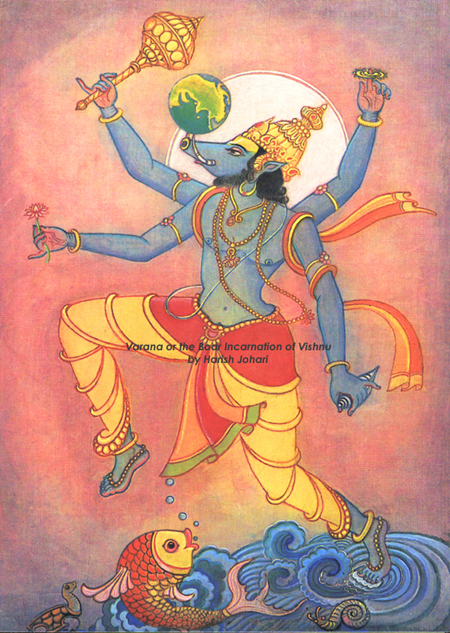
Varaha Boar Incarnation of Vishnu
Third incarnation of Vishnu : Varaha or the Boar incarnation of Vishnu : he killed the demon Hiranyaksha, recovered the stolen Veda's and released the Earth from the bottom of the ocean.
Click for a larger image of this Vishnu incarnation
Fourth incarnation of Vishnu : Narasingha or the Lion incarnation : as a creature who was half-lion and half-man, Vishnu killed the demon Hiranyashasipu, brother of Niranyaksha, who had gained the boon of immunity from attacks by man, beast or god.
Click for a larger image of this Vishnu incarnation
Fifth incarnation of Vishnu : Vamana or the Dwarf incarnation : he killed the demon Bali, who had gained dominion over the Earth and had chased the gods from the heavens. More can be read on the Vamana page.
Sixth incarnation of Vishnu : Parasurama : he killed the King Kartavirya, who had stolen the holy cow Kamadhenu, which could grant all desires.
Click for a larger image of this Vishnu incarnation
Seventh incarnation of Vishnu : Ram : he killed the demon King Ravana, who had abducted Sita. More on Ram can be read on the Ramayana page.
Click for a larger image of this Vishnu incarnation
Eigth incarnation of Vishnu : Krishna : he killed Kansa, son of a demon and the tyrannical King of Mathura. More on Krishna can be read in the Life of Krishna.
Click for a larger image of this Vishnu incarnation
Ninth incarnation of Vishnu : Buddha : Vishnu incarnated to remove suffering from the world. More on Buddha can be read on the Buddha page. While some Hindus may oppose to seeing Buddha as a Vishnu incarnation, many other Hindus in fact embrace Buddha as such and worship Buddha both in Buddhist temples as in Hindu temples.
Tenth Incarnation of Vishnu : Kalki : still to come at the end of the Kaliyuga or the present age of decline, when Vishnu will appear in person on Earth, seated on a white horse, Kalki, which is his tenth incarnation.

Saturday, 27 October 2012

The Legend of Radha Krishna


The Radha-Krishna amour is a love legend of all times. It's indeed hard to miss the many legends and paintings illustrating Krishna's love affairs, of which the Radha-Krishna affair is the most memorable. Krishna's relationship with Radha, his favorite among the 'gopis' (cow-herding maidens).
 There are numerous legends and stories of Radha and Krishna depicting their true love. Radha's devotion and dedication towards Sri Krishna is the most sincere one.

 Radha, also called Radhika, Radharani and Radhikarani, is the childhood friend and lover of Krishna in the Brahma Vaivarta Purana, and the Gita Govinda of the Vaisnava traditions of Hinduism. Radha is almost always depicted alongside Krishna and features prominently within the theology of today's Gaudiya Vaishnava sect, which regards Radha as the original Goddess or Shakti. Radha is also the principal object of worship in the Nimbarka Sampradaya, as Nimbarka, the founder of the tradition, declared that Radha and Krishna together constitute the absolute truth.

 Radha, daughter of Vrishabhanu, was the mistress of Krishna during that period of his life when he lived among the cowherds of Vrindavan. Since childhood they were close to each other - they played, they danced, they fought, they grew up together and wanted to be together forever, but the world pulled them apart. He departed to safeguard the virtues of truth, and she waited for him.

He vanquished his enemies, became the king, and came to be worshipped as a lord of the universe. She waited for him. He married Rukmini and Satyabhama, raised a family, fought the great war of Ayodhya, and she still waited. So great was Radha's love for Krishna that even today her name is uttered whenever Krishna is refered to, and Krishna worship is though to be incomplete without the deification of Radha.

 One day the two most talked about lovers come together for a final single meeting. Suradasa in his Radha-Krishna lyrics relates the various amorous delights of the union of Radha and Krishna in this ceremonious 'Gandharva' form of their wedding in front of five hundred and sixty million people of Vraj and all the gods and goddesses of heaven. The sage Vyasa refers to this as the 'Rasa'.

Age after age, this evergreen love theme has engrossed poets, painters, musicians and all Krishna devotees alike.
Radha Krishna Bhajans:

(Krishna bhajans) Na Mein Meera Na Mein Radha - by Mridul krishna shastri ji 

Lord Krishna playing flute for Radharani